
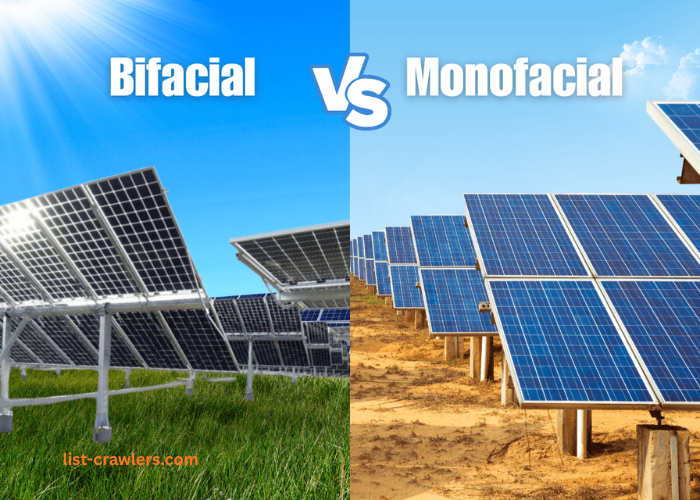
Bifacial and monofacial solar panels both turn sunlight into electricity, yet they do it with different physical designs that change how they perform in real installations. A monofacial module produces power mainly from the front face, where sunlight strikes the glass and reaches the cells. A bifacial module can generate power from the front and the back, capturing reflected and scattered light that reaches the rear side. This sounds like a simple upgrade, but the actual outcome depends on how the array is mounted, what surface lies beneath it, and how much rear-side light can reach the cells. In some settings, bifacial modules deliver meaningful extra energy across a year, while in others the gain is small because the rear face is starved of light. Understanding the differences helps homeowners and project planners choose the right module type for roofs, ground mounts, carports, and commercial arrays.
Two Panel Styles
- How Bifacial Gain Happens in Practice
Bifacial panels collect photons on both sides, but the rear-side contribution is not magic free energy; it is driven by geometry and reflectivity. Rear-side power comes from albedo, meaning the fraction of sunlight reflected from the ground or nearby surfaces. Bright surfaces like light gravel, white roofing membranes, concrete, or snow reflect more light upward, increasing bifacial gain. Dark soil, asphalt, and dense vegetation reflect less, reducing the benefit. Mounting height matters too. A module near a surface shows less reflected light on the rear side and more shading from the rails and framing. Raising the array can increase rear-side exposure and improve airflow cooling. Row spacing and tilt also affect how much reflected light reaches the rear. Tight row spacing can cause self-shading, where one row blocks reflected light from reaching the next row. Tilt can help by creating a better angle for reflected rays to strike the rear glass. These dynamics mean a bifacial module on a flat commercial roof with a white membrane may outperform the same module on a dark shingle roof where the rear is nearly blocked. Solar Providers often emphasize that bifacial performance depends more on site conditions than on nameplate wattage. Hence, a good design includes an albedo assumption and a mounting plan rather than assuming a fixed percentage gain. In many cases, bifacial panels produce a higher annual total, but the percentage varies with surface, height, and spacing.
- Monofacial Strengths in Common Roof Installs
Monofacial panels remain widely used because they deliver predictable output in the most common residential configuration: a roof-mounted setup with limited rear-side light. On typical pitched roofs, modules sit close to the roof surface, and the rear is partially blocked by racking, roof sheathing, and the narrow air gap. Even when some reflected light is present, it is often limited and inconsistent. In this scenario, the bifacial advantage may shrink, and the system may not gain enough additional energy to justify higher module costs or tighter design tolerances. Monofacial modules also simplify modeling because performance is driven mainly by front-side irradiance, temperature, shading, and soiling. Another benefit is reduced sensitivity to under-array conditions. With bifacial modules, dirt on the roof surface, changes in roof color, or debris accumulation can affect rear-side contribution over time. Monofacial performance is less tied to those variables. For homeowners who prioritize straightforward installation, common racking, and proven design assumptions, monofacial modules are often a practical fit. This does not mean that bifacial is unsuitable for roofs; it simply means the roof type matters. A high standoff roof mount over a bright surface can make bifacial more attractive, while a tight standoff over dark shingles may not.
- Temperature, Cooling, and Energy Yield Differences
Both module types are affected by heat, and in many climates, temperature behavior influences annual energy as much as nameplate ratings. Bifacial modules are often built with glass on both sides or with designs that allow more airflow around the cells. In ground mount or carport installations, this can improve cooling because air can move freely around the back. Cooler cells produce higher voltage, which can increase power output. However, the cooling advantage comes mostly from the mounting style, not from bifacial cells alone. A monofacial module on a well-ventilated ground-mount can also run cooler than a roof-mount module. Another yield factor is diffuse light, which is light scattered by clouds and haze. Bifacial modules can capture some of this from the rear if it reflects upward, but diffuse conditions also reduce strong directional reflections, so that the gain can be smaller than on clear days with high sun. Snow is a special case. Snow has high reflectivity, and bifacial modules in snowy regions can receive substantial rear-side contribution when snow covers the ground and the array is elevated enough. This can boost winter production, which is valuable when days are short. The overall energy yield comparison, therefore, depends on climate, mounting, and ground conditions, not only on the panel label.
Choosing the Right Module Type
Bifacial panels can deliver higher annual energy when the rear side receives reflected light, especially in ground mounts, carports, elevated racks, and sites with bright surfaces such as light gravel, concrete, or snow. Monofacial panels remain a practical choice for common roof installations where rear-side light is limited by tight mounting and dark roofing. The real performance difference depends on albedo, mounting height, row spacing, rear-side shading from hardware, and local climate conditions that affect reflectivity and cooling. Bifacial systems may require more intentional design to unlock gains, while monofacial systems offer predictable modeling and simpler assumptions. By matching module type to the installation environment and the available reflectivity, project planners can achieve reliable energy yield without paying for performance that the site cannot support.